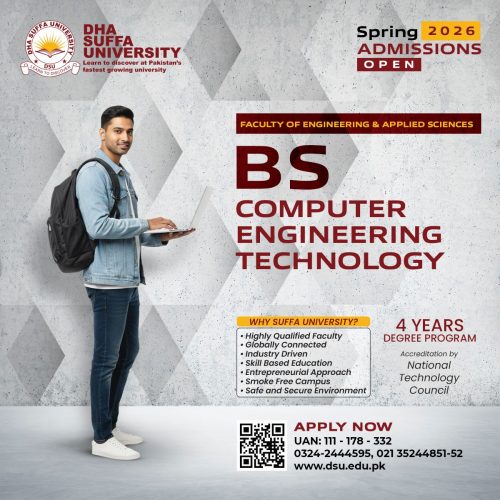
BACHELOR OF COMPUTER ENGINEERING
TECHNOLOGY (CET)
Computer Engineering Technology at DHA Suffa University (DSU)
Program Overview
The Bachelor of Science in Computer Engineering Technology (BS-CET) is an NTC-recognized program offered at Electrical Engineering Department that combines hands-on experience with modern hardware tools and strong software knowledge. The program is designed to bridge the gap between theory and practice, preparing students for real-world engineering challenges.
Students gain exposure to key areas of computer technology such as IoT, embedded systems, web and software development, while also building a solid foundation in electronics, communication systems, and computer networks. While essential theoretical concepts are covered, the program places a stronger emphasis on practical learning, laboratory work, and applied engineering skills, making the learning experience less rote and more impactful.
Career Paths
Through a wide range of electives, graduates can pursue the following career pathways (but not limited to):
- Hardware Design Engineer (Synthesis & Testing) – applying HDL skills for digital system design and verification
- Embedded Systems Engineer – designing and programming microcontroller- and processor-based systems
- Mechatronics / Robotics Engineer – working at the intersection of electronics, control systems, and automation
- Communication Systems / Network Engineer – designing and maintaining data and communication networks
- IoT Engineer – developing connected devices and smart systems
- Real-Time Operating Systems (RTOS) Engineer – building time-critical systems for industrial and embedded applications
- Firmware / Interfacing Engineer – developing low-level software that directly interfaces with hardware
- Control Systems Engineer
Discover a Future-Ready Career with BS Computer Engineering Technology at DHA Suffa University (DSU)
The BS Computer Engineering Technology (CET) program at DHA Suffa University (DSU) is a modern, NTC-recognized degree designed to prepare students for the rapidly evolving technology industry. DSU regarded as one of the best universities for BS Engineering.
DSU offers a balanced curriculum that combines strong theoretical foundations with extensive hands-on practical training..
This future-focused BS Computer Engineering Technology Program bridges the gap between classroom learning and real-world engineering applications. Students develop industry-relevant skills through laboratory work, applied projects, and exposure to modern engineering tools, ensuring they graduate as job-ready and competitive in local and international markets..
With a strong emphasis on practical engineering skills, the BS-CET degree equips students to design, build, test, and maintain computer-based systems across diverse industries..
Program Highlights – BS Computer Engineering Technology
The BS Computer Engineering Technology curriculum at DSU provides in-depth knowledge in both hardware and software domains, including:
- Internet of Things (IoT) and Smart Systems
- Embedded Systems and Microcontroller-Based Design
- Electronics and Digital System Design
- Communication Systems and Computer Networks
- Web Development and Software Engineering Fundamentals
Unlike traditional programs, DSU’s BS-CET program places greater focus on applied learning, laboratory experimentation, and real-world problem solving, making it one of the most practical and career-oriented computer engineering technology degrees in Pakistan.
Professional Career Paths
Graduates of the BS Computer Engineering Technology program at DHA Suffa University (DSU) gain strong technical and practical skills that prepare them for high-demand careers, higher studies, and long-term professional growth in the engineering and technology sector. The program focuses on hardware systems, embedded technology, IoT, networking, control systems, and software–hardware integration, making graduates industry-ready and confident. After completing the degree, graduates can work as Hardware Design Engineers, where they design, test, and verify digital systems using HDL and modern hardware tools. As Embedded Systems Engineers, they design and deploy microcontroller- and processor-based systems for industrial and commercial use. Those interested in automation and smart machines can pursue careers as Mechatronics and Robotics Engineers, working with electronics, robotics, and control systems.
Graduates can also become Communication Systems or Network Engineers, managing data communication and computer networking infrastructures, or IoT Engineers, developing smart and connected devices for automation, healthcare, and smart cities. Other career options include Firmware / Interfacing Engineers, who develop low-level software that directly communicates with hardware, and Control Systems Engineers, who design and optimize automated systems used in industrial environments.
In addition to strong career opportunities, the BS Computer Engineering Technology at DSU provides a solid foundation for higher education, professional certifications, and research-based careers. Graduates are well-prepared to pursue postgraduate studies, specialize in emerging technologies, or enter the engineering workforce with confidence. With their broad skill set, DSU graduates are highly employable in technology and software companies, telecommunications and networking firms, industrial automation and manufacturing sectors, and research and development organizations. With CPEC Project coming up, the CET graduates will good opportunities in CPEC project due to more Spilled training..
This program is an excellent choice for students looking for a future-focused engineering degree with strong career prospects and growth opportunities..
Why Choose BS Computer Engineering Technology at DSU?
DHA Suffa University (DSU) is recognized as one of the leading universities in Karachi for BS Computer Engineering Technology, offering a career-focused and industry-aligned learning environment that prepares students for modern engineering challenges.
Foreign-Qualified & Experienced Faculty
The BS Computer Engineering Technology program is taught by highly qualified faculty members holding foreign degrees, extensive teaching experience, and strong industry backgrounds. Faculty are actively involved in internationally recognized research and funded projects, providing students with hands-on exposure to real-world engineering problems under expert supervision.
State-of-the-Art Classrooms & Engineering Labs
DSU offers modern multimedia-equipped classrooms and advanced engineering laboratories designed to promote hands-on learning. Students gain practical experience in embedded systems, IoT, robotics, communication systems, control systems, and power engineering using the latest testing, measurement, and simulation tools.
International Education Resource Center (IERC)
The International Education Resource Center (IERC) enables BS Computer Engineering Technology students to participate in international semester exchange programs, foreign internships, and global mobility opportunities, broadening their academic and professional perspectives.
Holistic Student Development
Through co-curricular activities, student societies, workshops, and competitions, DSU focuses on overall personality development while maintaining high academic standards.
Outcome-Based Education (OBE)
DSU follows a globally aligned Outcome-Based Education (OBE) framework to ensure graduates develop measurable technical, analytical, and professional skills required to succeed in today’s competitive engineering industry.
This integrated academic and practical approach makes DHA Suffa University a top choice and a leading institution for BS Computer Engineering Technology in Pakistan.
ELIGIBILITY CRITERIA FOR BS (COMPUTER ENGINEERING TECHNOLOGY)
- Intermediate or an equivalent examination (Pre-Engineering/ ICS/ General Science/ DAE) with at least 50% marks; Or
- A-Level with minimum 3 passes in principal subjects
- Applicants with O-Level / A-Level and Technical studies must submit equivalence from IBCC
- At least 50% marks in DSU Entrance Test
REQUIRED DOCUMENTS
Applicants are required to bring a set of copied documents for application processing:- Matriculation / O-Level / Equivalent Marks Sheet / Statements and Certificates
- Intermediate / Equivalent / A-Level Marks Sheet / Statements and Certificates
- Applicants with O-Level / A-Level and Technical studies must submit equivalence from IBCC
- College Provisional Certificate / Promotion Certificate by the respective Board
- A copy of CNIC and B-Form
- 3 passport-sized photographs with white background
- Admit Card / Statement of Entry is required, if awaiting result
| SEMESTER – I | ||||
|---|---|---|---|---|
| Sr. No. | Course Title | Knowledge Area / Domain | Credit Hrs. (Th+Lab) | Weekly Contact Hrs. (Th+Lab) |
| 1 | Functional English | Art & Humanities-I | 3+0 | 3+0 |
| 2 | Applied Physics | Natural Sciences-I | 2+1 | 2+3 |
| 3 | Calculus and Analytical Geometry | Natural Sciences-II | 3+0 | 3+0 |
| 4 | Islamic Studies / Ethics | Art & Humanities-II | 2+0 | 2+0 |
| 5 | Information and Communication Technologies | Computing-I | 1+1 | 1+3 |
| 6 | Electric Circuits | Computer Engineering Technology Foundation-I | 2+2 | 2+6 |
| Subtotal | 13+4 = 17 | 13+12 = 25 | ||
| SEMESTER – 2 | ||||
| Sr. No. | Course Title | Knowledge Area / Domain | Credit Hrs. (Th+Lab) | Weekly Contact Hrs. (Th+Lab) |
| 1 | Computer Programming | Computing-II | 1+2 | 1+6 |
| 2 | Electronic Devices and Circuits | Computer Engineering Technology Foundation-II | 2+1 | 2+3 |
| 3 | Technical Drawing | Computer Engineering Technology Foundation-III | 0+1 | 0+3 |
| 4 | Linear Algebra | Natural Sciences-III | 3+0 | 3+0 |
| 5 | Pakistan Studies | Art & Humanities-III | 2+0 | 2+0 |
| 6 | Communication Skills | Art & Humanities-IV | 3+0 | 3+0 |
| 7 | Digital Logic Design | Computer Engineering Technology Foundation-VI | 2+1 | 2+3 |
| Subtotal | 13+5 = 18 | 13+15 = 28 | ||
| SEMESTER – 3 | ||||
| Sr. No. | Course Title | Knowledge Area / Domain | Credit Hrs. (Th+Lab) | Weekly Contact Hrs. (Th+Lab) |
| 1 | Operating Systems | Computer Engineering Technology Foundation-IV | 2+1 | 2+3 |
| 2 | Signals and Systems | Computer Engineering Technology Foundation-V | 2+1 | 2+3 |
| 3 | Data Structures and Algorithms | Computing-III | 1+2 | 1+6 |
| 4 | Technical Writing | Art & Humanities-V | 3+0 | 3+0 |
| 5 | GE- Elective-1 | University Elective-I | 3+0 | 3+0 |
| 6 | Computer Hardware Systems | Computer Engineering Technology Foundation-VII | 1+1 | 1+3 |
| Subtotal | 12+5 = 17 | 12+15 = 27 | ||
| SEMESTER – 4 | ||||
| Sr. No. | Course Title | Knowledge Area / Domain | Credit Hrs. (Th+Lab) | Weekly Contact Hrs. (Th+Lab) |
| 1 | Instrumentation and Data Acquisition | Computer Engineering Technology Breadth Core-I | 1+1 | 1+3 |
| 2 | Web Technologies | Computer Engineering Technology Breadth Core-II | 1+2 | 1+6 |
| 3 | Mobile Application Development | Computer Engineering Technology Breadth Core-III | 1+2 | 1+6 |
| 4 | Database Applications | Computer Engineering Technology Breadth Core-IV | 1+1 | 1+3 |
| 5 | Embedded Systems | Computer Engineering Technology Breadth Core-V | 1+1 | 1+3 |
| 6 | Environment, Health, and Safety | Civics and Community Engagement | 3+0 | 3+0 |
| Subtotal | 8+7 = 15 | 8+21 = 29 | ||
| SEMESTER – 5 | ||||
| Sr. No. | Course Title | Knowledge Area / Domain | Credit Hrs. (Th+Lab) | Weekly Contact Hrs. (Th+Lab) |
| 1 | Systems and Network Administration | Computer Engineering Technology Breadth Core-VI | 1+1 | 1+3 |
| 2 | Network Technologies | Computer Engineering Technology Breadth Core-VII | 2+1 | 2+3 |
| 3 | Organizational Behavior | Management Sciences-I | 2+0 | 2+0 |
| 4 | Depth Elective-1 | Computer Engineering Technology Depth Elective-I | 1+1 | 1+3 |
| 5 | Depth Elective-2 | Computer Engineering Technology Depth Elective-II | 1+2 | 1+6 |
| 6 | Project-1 | Senior Design Project-I | 0+3 | 0+9 |
| Subtotal | 7+8 = 15 | 7+24 = 31 | ||
| SEMESTER – 6 | ||||
| Sr. No. | Course Title | Knowledge Area / Domain | Credit Hrs. (Th+Lab) | Weekly Contact Hrs. (Th+Lab) |
| 1 | Depth Elective-3 | Computer Engineering Technology Depth Elective-III | 1+2 | 1+6 |
| 2 | Depth Elective-4 | Computer Engineering Technology Depth Elective-IV | 2+1 | 2+3 |
| 3 | IDTE-1 | Inter Disciplinary Elective-I | 2+1 | 2+3 |
| 4 | Technopreneurship | Management Sciences-II | 3+0 | 3+0 |
| 5 | Professional Ethics | Art & Humanities-VII | 2+0 | 2+0 |
| 6 | Project-2 | Senior Design Project-II | 0+3 | 0+9 |
| Subtotal | 10+7 = 17 | 10+21 = 31 | ||
| SEMESTER – 7 | ||||
| Sr. No. | Course Title | Knowledge Area / Domain | Credit Hrs. (Th+Lab) | Weekly Contact Hrs. (Th+Lab) |
| 1 | Supervised Industrial Training (Optional) | Computer Engineering Technology Domain Industrial Training | 16 | 4 (per week) |
| Semester VII (Framework-B) | ||||
| CPT-411 | Cloud Computing | Computer Engineering Technology Breadth Core-VIII | 1+2 | 1+6 |
| IDE-412 | IDTE-2 | Inter Disciplinary Elective-II | 2+1 | 2+3 |
| UGE-413 | GE- Elective-2 | University Elective-II | 3+0 | 3+0 |
| CPT-414 | Depth Elective-5 | Computer Engineering Technology Depth Elective-V | 2+1 | 2+3 |
| CPT-415 | Depth Elective-6 | Computer Engineering Technology Depth Elective-VI | 2+2 | 2+6 |
| Subtotal | 10+6 = 16 | 10+18 = 28 | ||
| SEMESTER – 8 | ||||
| Sr. No. | Course Title | Knowledge Area / Domain | Credit Hrs. (Th+Lab) | Weekly Contact Hrs. (Th+Lab) |
| 1 | Supervised Industrial Training (Compulsory) | Computer Engineering Technology Domain Industrial Training | 16 | 40 (Per Week) |
| Subtotal | 0+16 = 16 | 0+48 = 48 | ||
| Total Credit Hours & Contact Hours in Four Years | 63+68 = 131 | 63+204 = 267 | ||
| Theory vs Practical with respect to Contact Hours | Theory: 63 (23.59%) Practical: 204 (76.40%) | |||
| Semester | Admission Charges (One Time) |
Caution Money Charges (One Time) |
Per Cr. Hour | Per Cr. Hour @ 25% Discount |
Cr. Hours | Semester Registration | Tuition Fee | Examination Fee | Total Fee |
|---|---|---|---|---|---|---|---|---|---|
| 1st Semester | 15,000 | 10,000 | 4,000 | 3,000 | 17 | 12,350 | 51,000 | 6,000 | 94,350 |
| 2nd and subsequent semesters* | 0 | 0 | 4,000 | 3,000 | 18 | 12,350 | 54,000 | 6,000 | 72,350 |
4 year Computer Engineering Technology program consists of 131 credit hours.
*Fee of subsequent semesters will vary as per the number of credit hours the student has enrolled in the particular semester.